Bootstrapping
Bootstrapping is a resampling technique for generating a distribution of datasets. For a dataset with \(N\) training points, \(N\) random samples are taken with replacement for each bootstrapped dataset. In this tutorial we will be training an ensemble of models, with each model trained on a bootstrapped sample of the original dataset. Applying this technique allows us to quantify uncertainty stemming from the data.
Dataset
[1]:
# Set a seed for reproducibility
import torch
import torch.nn as nn
from torch.utils.data import TensorDataset
from torch.utils.data import DataLoader

torch.manual_seed(0)

# Generate dataset and grid
X = torch.rand(100, 1) * 0.5
x_grid = torch.linspace(-5, 5, 1000).reshape(-1, 1)

# Define function
def target_toy(x, seed):
    torch.manual_seed(seed)
    epsilons = torch.randn(3) * 0.02
    return (
        x + 0.3 * torch.sin(2 * torch.pi * (x + epsilons[0])) +
        0.3 * torch.sin(4 * torch.pi * (x + epsilons[1])) + epsilons[2]
    )

# Generate target values with different seeds
Y = torch.stack([target_toy(x, seed) for x, seed in zip(X, range(X.shape[0]))])
Model
[2]:
class GenericNet(nn.Module):
    def __init__(self, input_dim):
        super(GenericNet, self).__init__()
        self.input_dim = input_dim

        self.net = nn.Sequential(
            nn.Linear(in_features=input_dim, out_features=16),
            nn.ELU(),
            nn.Linear(in_features=16, out_features=16),
            nn.ELU(),
            nn.Linear(in_features=16, out_features=1)
        )
        # Additional layers can be added here based on the architecture
        # Apply Xavier uniform initialization to the weights
        self.init_weights(self.net)

    def forward(self, x):
        return self.net(x)

    def init_weights(self, m):
        if isinstance(m, nn.Linear):
            nn.init.xavier_uniform_(m.weight)
            m.bias.data.fill_(0.01)


class PriorNet(nn.Module):
    def __init__(self, beta):
        super(PriorNet, self).__init__()
        self.prior = GenericNet(input_dim=1)  # Specify the input dimension
        self.trainable = GenericNet(input_dim=1)  # Specify the input dimension
        self.beta = beta

    def forward(self, x):
        x1 = self.prior(x)
        x2 = self.trainable(x)
        return self.beta * x1 + x2
Training
Ensemble
[3]:
import push.bayes.ensemble
# Combine X and Y into a TensorDataset
dataset = TensorDataset(X, Y)

# Create a DataLoader for batch processing during training
batch_size = 100  # Adjust according to your needs
train_loader = DataLoader(dataset, batch_size=batch_size, shuffle=True)


n=8
epochs=500
lr = 0.03

boot_ensemble = push.bayes.ensemble.train_deep_ensemble(
        train_loader,
        torch.nn.MSELoss(),
        epochs,
        GenericNet, 1,
        lr=lr,
        num_devices=2,
        num_ensembles=n,
        bootstrap=True
    )

boot_prior_ensemble = push.bayes.ensemble.train_deep_ensemble(
        train_loader,
        torch.nn.MSELoss(),
        epochs,
        PriorNet, 0.5,
        lr=lr,
        num_devices=2,
        num_ensembles=n,
        bootstrap=True,
        prior = True
    )

no_boot_ensemble = push.bayes.ensemble.train_deep_ensemble(
        train_loader,
        torch.nn.MSELoss(),
        epochs,
        GenericNet, 1,
        lr=lr,
        num_devices=2,
        num_ensembles=n,
        bootstrap=False
    )

no_boot_prior_ensemble = push.bayes.ensemble.train_deep_ensemble(
        train_loader,
        torch.nn.MSELoss(),
        epochs,
        PriorNet, 0.5,
        lr=lr,
        num_devices=2,
        num_ensembles=n,
        bootstrap=False,
        prior = True
    )
100%|██████████| 500/500 [00:16<00:00, 30.04it/s, loss=tensor(0.0024)]
100%|██████████| 500/500 [00:18<00:00, 26.49it/s, loss=tensor(0.0030)]
100%|██████████| 500/500 [00:12<00:00, 41.66it/s, loss=tensor(0.0027)]
100%|██████████| 500/500 [00:15<00:00, 32.64it/s, loss=tensor(0.0031)]
SWAG
[4]:
import push.bayes.swag

pretrain_epochs = 250
swag_epochs = 250
boot_swag = push.bayes.swag.train_mswag(
    train_loader,
    torch.nn.MSELoss(),
    pretrain_epochs,
    swag_epochs,
    GenericNet, 1,
    num_devices = 2,
    num_models = n,
    lr = lr,
    bootstrap=True,
    mswag_state={}
)

boot_prior_swag = push.bayes.swag.train_mswag(
    train_loader,
    torch.nn.MSELoss(),
    pretrain_epochs,
    swag_epochs,
    PriorNet, 0.5,
    num_devices = 2,
    num_models = n,
    lr = lr,
    bootstrap=True,
    prior = True,
    mswag_state={}
)

no_boot_swag = push.bayes.swag.train_mswag(
    train_loader,
    torch.nn.MSELoss(),
    pretrain_epochs,
    swag_epochs,
    GenericNet, 1,
    num_devices = 2,
    num_models = n,
    lr = lr,
    bootstrap=False,
    mswag_state={}
)

no_boot_prior_swag = push.bayes.swag.train_mswag(
    train_loader,
    torch.nn.MSELoss(),
    pretrain_epochs,
    swag_epochs,
    PriorNet, 0.5,
    num_devices = 2,
    num_models = n,
    lr = lr,
    bootstrap=False,
    prior = True,
    mswag_state={}
)
  0%|          | 0/250 [00:00<?, ?it/s]100%|██████████| 250/250 [00:08<00:00, 30.28it/s, loss=tensor(0.0069)]
100%|██████████| 250/250 [00:11<00:00, 21.44it/s, loss=tensor(0.0029)]
100%|██████████| 250/250 [00:09<00:00, 26.14it/s, loss=tensor(0.0053)]
100%|██████████| 250/250 [00:15<00:00, 15.89it/s, loss=tensor(0.0030)]
100%|██████████| 250/250 [00:05<00:00, 46.62it/s, loss=tensor(0.0078)]
100%|██████████| 250/250 [00:08<00:00, 28.65it/s, loss=tensor(0.0033)]
100%|██████████| 250/250 [00:06<00:00, 38.30it/s, loss=tensor(0.0059)]
100%|██████████| 250/250 [00:11<00:00, 20.93it/s, loss=tensor(0.0026)]
Inference
[5]:
boot_ensemble_output = boot_ensemble.posterior_pred(x_grid, f_reg=True, mode=["mean", "std", "pred"])
boot_prior_ensemble_output = boot_prior_ensemble.posterior_pred(x_grid, f_reg=True, mode=["mean", "std", "pred"])
no_boot_prior_ensemble_output = no_boot_prior_ensemble.posterior_pred(x_grid, f_reg=True, mode=["mean", "std", "pred"])
no_boot_ensemble_output = no_boot_ensemble.posterior_pred(x_grid, f_reg=True, mode=["mean", "std", "pred"])
boot_swag_output = boot_swag.posterior_pred(x_grid, f_reg=True, mode=["mean", "std", "pred"])
boot_prior_swag_output = boot_prior_swag.posterior_pred(x_grid, f_reg=True, mode=["mean", "std", "pred"])
no_boot_swag_output = no_boot_swag.posterior_pred(x_grid, f_reg=True, mode=["mean", "std", "pred"])
no_boot_prior_swag_output = no_boot_prior_swag.posterior_pred(x_grid, f_reg=True, mode=["mean", "std", "pred"])
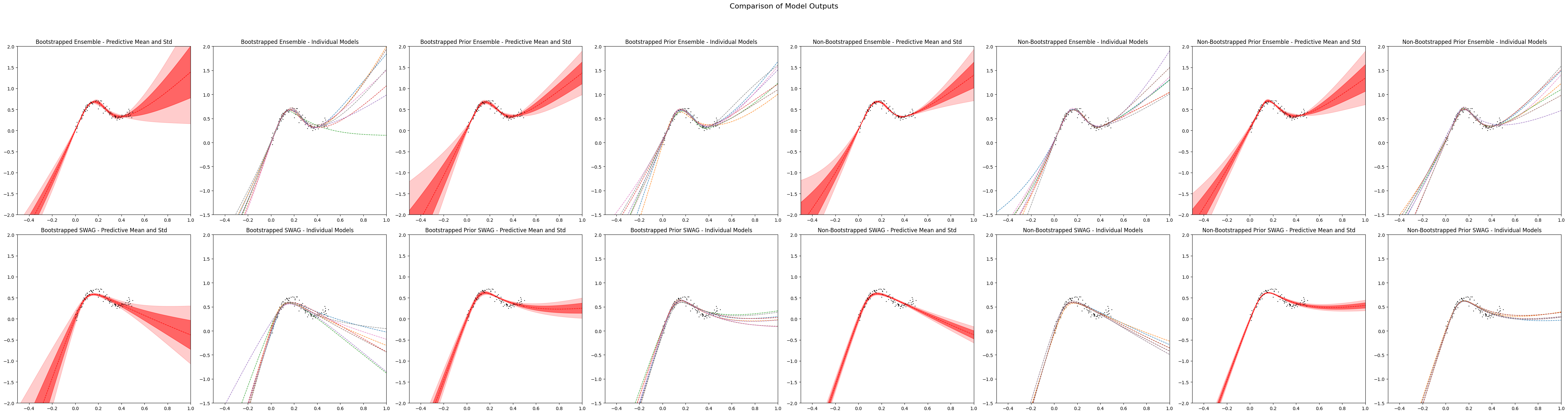
Visualization
[6]:
import matplotlib.pyplot as plt
import torch

def plot_ensemble_and_individual(outputs, num_models, title, axs, col_start):
    # Ensemble outputs
    axs[col_start].plot(X, Y, "kx", label="Toy data", markersize=1)
    axs[col_start].set_xlim(-0.5, 1)
    axs[col_start].set_ylim(-2, 2)
    axs[col_start].plot(x_grid, outputs["mean"], "r--", linewidth=1)
    axs[col_start].fill_between(x_grid.reshape(1, -1)[0], (outputs["mean"] - outputs["std"]).squeeze(), (outputs["mean"] + outputs["std"]).squeeze(), alpha=0.5, color="red")
    axs[col_start].fill_between(x_grid.reshape(1, -1)[0], (outputs["mean"] + 2 * outputs["std"]).squeeze(), (outputs["mean"] - 2 * outputs["std"]).squeeze(), alpha=0.2, color="red")
    axs[col_start].set_title(f"{title} - Predictive Mean and Std")

    # Individual model outputs
    axs[col_start + 1].plot(X, Y, "kx", label="Toy data", markersize=1)
    axs[col_start + 1].set_xlim(-0.5, 1)
    axs[col_start + 1].set_ylim(-1.5, 2)
    for j in range(num_models):
        axs[col_start + 1].plot(x_grid, torch.tensor([sublist[j] for sublist in outputs["pred"]]), linestyle="--", linewidth=1)
    axs[col_start + 1].set_title(f"{title} - Individual Models")

def plot_all():
    fig, axs = plt.subplots(nrows=2, ncols=8, figsize=[48, 12])  # Adjust dimensions as needed

    # Plot bootstrapped and non-bootstrapped ensemble and individual models in one row
    plot_ensemble_and_individual(boot_ensemble_output, n, "Bootstrapped Ensemble", axs[0, :], 0)
    plot_ensemble_and_individual(boot_prior_ensemble_output, n, "Bootstrapped Prior Ensemble", axs[0, :], 2)
    plot_ensemble_and_individual(no_boot_ensemble_output, n, "Non-Bootstrapped Ensemble", axs[0, :], 4)
    plot_ensemble_and_individual(no_boot_prior_ensemble_output, n, "Non-Bootstrapped Prior Ensemble", axs[0, :], 6)

    # Plot SWAG models in another row
    plot_ensemble_and_individual(boot_swag_output, n, "Bootstrapped SWAG", axs[1, :], 0)
    plot_ensemble_and_individual(boot_prior_swag_output, n, "Bootstrapped Prior SWAG", axs[1, :], 2)
    plot_ensemble_and_individual(no_boot_swag_output, n, "Non-Bootstrapped SWAG", axs[1, :], 4)
    plot_ensemble_and_individual(no_boot_prior_swag_output, n, "Non-Bootstrapped Prior SWAG", axs[1, :], 6)

    # Set overall title and adjust layout
    fig.suptitle('Comparison of Model Outputs', fontsize=16, y=1.05)
    plt.tight_layout()
    plt.show()

# Call this function to generate all plots
plot_all()
The Kernel crashed while executing code in the current cell or a previous cell.

Please review the code in the cell(s) to identify a possible cause of the failure.

Click <a href='https://aka.ms/vscodeJupyterKernelCrash'>here</a> for more info.

View Jupyter <a href='command:jupyter.viewOutput'>log</a> for further details.
[1] Kevin Murphy. Probabilistic Machine Learning Advanced Topics. Chapter 17. The MIT Press: Adaptive computation and machine learning series (2023). Cambridge, Massachusetts.